
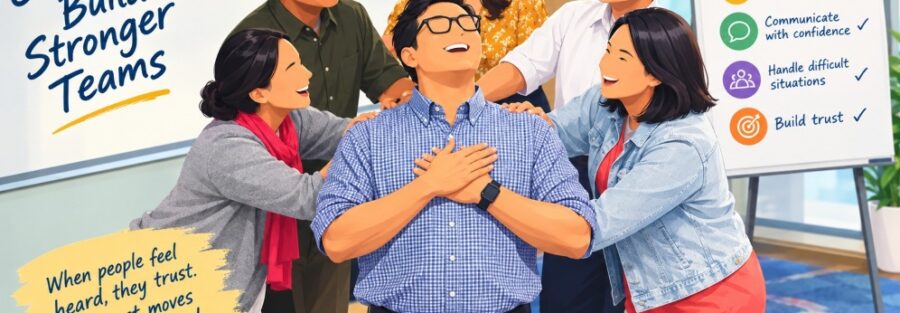
The Trust Test: What Happens When Leaders Are Caught Off Guard?
A difficult question in a meeting. A challenge from a team member. A disagreement with a stakeholder. In these moments, leadership is not just about what you know. It is about how you respond — and how your response makes others feel.
The Trust Equation describes trustworthiness through four factors: Credibility, Reliability, Intimacy and Self-Orientation. Credibility is about whether people believe you are knowledgeable and objective. Reliability is whether you do what you say. Intimacy reflects whether people feel you genuinely connect with them and care about their success. Self-Orientation is the degree to which people perceive you as being focused on yourself rather than their interests.
While trust is built over time, it is often revealed in small, spontaneous moments.
This is where Think on Your Feet® becomes powerful.
Turning trust into something people can hear and feel
Think on Your Feet® gives leaders practical structures to organise ideas quickly, communicate with clarity, and respond effectively under pressure. It includes six core logical plans, along with bridging techniques for handling difficult questions, objections and emotionally charged situations.
Consider what this looks like in practice:
Credibility: Instead of rambling when challenged, a leader can structure their thinking, separate facts from perspectives and explain complex ideas simply. Clarity signals competence.
Intimacy: Bridging techniques encourage leaders to acknowledge the person, clarify what they are really asking and respond to their concerns. This changes the experience from “I need to defend myself” to “I’m listening to you.”
Self-Orientation: When leaders focus on the listener’s needs, concerns and perspective — rather than simply protecting their own position — the conversation feels more inclusive and less self-serving.
And there is an important connection with sense-making.
In an AI world, sense-making becomes human work
AI can generate answers at extraordinary speed. But leaders still need to decide: What matters? What does this mean for us? How do I explain it? What does my team need to hear right now?
That requires judgement, empathy and the ability to make meaning together.
The strongest leaders therefore need both trust-building skills and sense-making skills. They need to think clearly and communicate in a way that creates confidence, safety and connection.
Because leadership is not simply about having the answer.
It is about helping people make sense of what is happening — and trusting you enough to move forward with you.
FAQ
Is Think on Your Feet® only for presentations?
No. It is designed for everyday, spontaneous conversations, including difficult questions, meetings, conflict and stakeholder discussions.
Can it strengthen leadership development?
Yes. The skills support clearer thinking, influence, difficult conversations and more confident leadership communication.
Why combine communication and trust-building?
Because trust is experienced through behaviour. How leaders listen, respond, explain and handle pressure can directly shape how trustworthy they feel.
Where can organisations use these skills?
They can complement Leadership Training Singapore, Leadership Course Singapore, Leadership Course Malaysia, leadership courses Indonesia, EQ workshops, leadership development courses and Better Conversation Skills programmes.